.webp)
Companies and software referenced
Each company links to an official product page or primary source relevant to this guide. Monogram tiles identify the referenced organisation and do not imply endorsement.
Insurance distribution management software governs the relationship between an insurer and the producers, agencies, brokers and other channels authorised to sell its products. Duck Creek Distribution Management, Sircon for Carriers, Majesco Distribution Management, AgentSync Manage and Producerflow cover different combinations of onboarding, licensing, appointments, hierarchies, compensation, performance and self service. Choose by replaying one producer journey across the systems that own regulatory, policy and payment records.
What should insurance distribution management software control?
Distribution management sits between regulatory producer information, insurer contracts, channel relationships, product authority, policy transactions and compensation. Products vary in how much of that boundary they own. A broad feature list cannot show whether one producer is truly ready to sell or whether a later change is handled correctly. Define the distributor types, jurisdictions, product lines, regulatory sources, contracting route, appointment policy, hierarchy, compensation authority and policy system handoffs before comparing platforms.
Which criteria matter when assessing insurance distribution management software?
We reviewed current official product pages and current NAIC and NIPR material. We separated documented product scope from Provena editorial analysis, then compared producer records, onboarding, licensing, appointments, relationships, compensation, performance, integrations and audit evidence. No paid placement, invented product score or universal compliance claim influenced the shortlist. The review uses official documentation and independent practical analysis.
| Choice | Best fit | Core strength | Main tradeoff |
|---|---|---|---|
| Duck Creek Distribution Management | property and casualty insurers seeking broad producer relationship and compensation control | onboarding, compliance, hierarchy, compensation, performance and agency self service in one distribution platform | the broad scope requires careful boundaries with policy, billing, customer and regulatory systems |
| Sircon for Carriers | United States insurers prioritising producer credentials, appointments, compliance and compensation | connected producer records, regulatory data, onboarding, appointment and compensation workflows | jurisdiction, product and operating rules still need qualified review and complete integration testing |
| Majesco Distribution Management | insurers managing several channels, product lines and compensation structures | multi channel distribution, producer relationships, compliance, compensation and performance insight | buyers should confirm the contracted modules, regional coverage and boundaries with the wider Majesco environment |
| AgentSync Manage | carriers, agencies and managing general agents seeking modern producer management and regulatory data workflows | onboarding, licensing, appointments, terminations, distribution partner data and application programming interfaces | broader commission, policy and performance requirements may sit in connected products or systems |
| Producerflow | insurance organisations seeking modular onboarding, licensing, appointment and compliance control | a focused set of producer lifecycle modules with reporting and integration options | the team must verify how wider hierarchy, compensation, policy and enterprise requirements are covered |
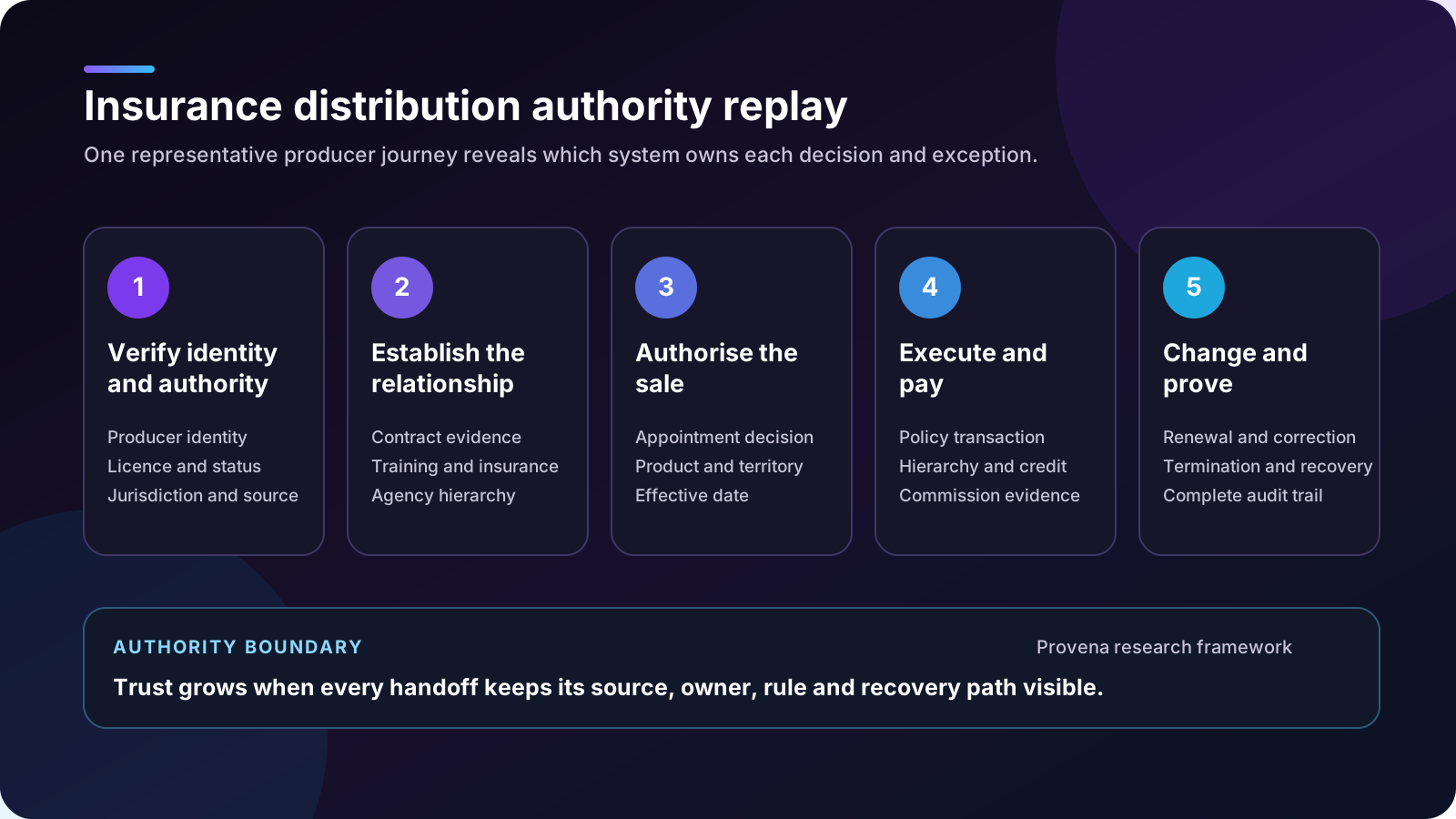
Which producer readiness replay reveals the real distribution system boundary?
Create one prospective agency and producer who will sell two products across two jurisdictions. Verify identity and licence information, collect contracting evidence, complete training, make the required appointment decision, authorise the correct product, write a policy, derive compensation, change the hierarchy, renew one credential, terminate another relationship and reconstruct every decision from the audit record.
Keep record authority explicit. State systems and NIPR provide regulatory information. The distribution platform coordinates the insurer relationship and readiness decision. The insurance policy administration system guide explains why the policy transaction needs its own authority. The insurance software types guide maps the wider operating architecture.
Four criteria separate these platforms once the feature lists are set aside, and each has a test. Record authority: ask which system is the one a regulator would be shown, and whether the platform holds the licence fact or a cached copy of somebody else’s. A cached copy is workable and common; a cached copy nobody can date is not.
Decision versus record. Some platforms decide whether a producer may be appointed and then act on that decision; others record a decision taken elsewhere. Both are legitimate purchases and they are not interchangeable. The test is to present a producer who is licensed in one state and not another for the same product, and see whether the system refuses the appointment or files the exception for a human.
Compensation derivation. Ask whether commission is derived from the hierarchy as it stood on the date of sale, or applied afterwards from the hierarchy as it stands today. Move a producer between agencies mid term, then run a renewal on a policy they wrote before the move. A platform that pays the new hierarchy on the old policy will produce a reconciliation argument every quarter.
Reconstruction. Change a hierarchy, terminate one relationship and reinstate another, then ask the platform to show what authority applied on a single historic date and who approved each step. This is the criterion most demonstrations are not built to answer, and it is the one an audit actually asks. A platform that answers it from its own records rather than from exported spreadsheets is worth a premium the feature comparison will not show.
Which insurance distribution management software deserve a practical test?
Duck Creek Distribution Management: where does it fit?
Duck Creek describes a carrier distribution platform that connects onboarding, licensing, appointments, compensation, performance and agency self service. Test producer identity, relationship changes, NIPR data, policy context, commission adjustments and recovery across the actual insurer architecture. Suits property and casualty insurers seeking broad producer relationship and compensation control. Strongest where onboarding, compliance, hierarchy, compensation, performance and agency self service in one distribution platform matters. Test that the broad scope requires careful boundaries with policy, billing, customer and regulatory systems.
Sircon for Carriers: where does it fit?
Vertafore presents Sircon for Carriers as a producer lifecycle platform built around Producer Central, onboarding, self service and compensation. Prove the exact source, effective date, exception route and downstream use for every credential and appointment result. Suits united States insurers prioritising producer credentials, appointments, compliance and compensation. Strongest where connected producer records, regulatory data, onboarding, appointment and compensation workflows matters. Test that jurisdiction, product and operating rules still need qualified review and complete integration testing.
Majesco Distribution Management: where does it fit?
Majesco describes distribution management across channels, product lines, hierarchies, compensation and analytics. Test one conventional agency route and one newer channel without assuming that shared product names create shared authority. Suits insurers managing several channels, product lines and compensation structures. Strongest where multi channel distribution, producer relationships, compliance, compensation and performance insight matters. Test that buyers should confirm the contracted modules, regional coverage and boundaries with the wider Majesco environment.
AgentSync Manage: where does it fit?
AgentSync Manage focuses on producer management and compliance workflows. Test identity matching, current employer, licences, appointments, actions, terminations, data refresh, self service and the handoff to contracting, policy and compensation systems. Suits carriers, agencies and managing general agents seeking modern producer management and regulatory data workflows. Strongest where onboarding, licensing, appointments, terminations, distribution partner data and application programming interfaces matters. Test that broader commission, policy and performance requirements may sit in connected products or systems.
Producerflow: where does it fit?
Producerflow presents modular producer onboarding, licensing, appointment and compliance workflows. Prove source data, state variation, document evidence, relationship ownership, exceptions, exports and the route into the rest of the insurance stack. Suits insurance organisations seeking modular onboarding, licensing, appointment and compliance control. Strongest where a focused set of producer lifecycle modules with reporting and integration options matters. Test that the team must verify how wider hierarchy, compensation, policy and enterprise requirements are covered.
Which producer lifecycle events must the software handle without a workaround?
Distribution management fails at the transitions. Write these events into the evaluation script and ask each vendor to show the record, the rule and the downstream effect for every one.
| Lifecycle event | Record that must change | Downstream effect to verify |
|---|---|---|
| Onboarding a new producer | Identity, licence, background and contract | Producer cannot be paid or appointed until every readiness rule passes |
| Appointment in a new jurisdiction | Appointment record and regulatory filing | Sales permitted only for the lines and states now appointed |
| Licence lapse or renewal | Licence status and effective dates | Automatic hold on new business and a task for the compliance owner |
| Hierarchy change | Reporting line and override structure | Commission splits recalculate from the effective date, not the entry date |
| Compensation plan change | Plan, rate and effective period | Historical statements unchanged, future statements correct |
| Termination | Contract end, appointment terminations and final settlement | Regulatory notices sent and access removed on the right date |
A platform that handles all six with an audit trail is a system of record. One that needs a spreadsheet for any of them is a workflow tool that will need a second system behind it.
How should a team introduce its chosen approach to insurance distribution management software?
Test insurance distribution management software against a representative workflow before committing. First test: Define producer, agency, broker, managing general agent and other distributor records separately. Include ordinary records, difficult exceptions and the people who will own the system after selection.
- Define producer, agency, broker, managing general agent and other distributor records separately.
- Name the authoritative source for identity, licence, appointment, contract, training and relationship data.
- Map readiness rules by jurisdiction, insurer, product, line of authority and effective date.
- Test onboarding, appointment, hierarchy, compensation, renewal, termination and correction as one journey.
- Confirm policy, billing, customer, accounting, regulatory and data warehouse handoffs with failure recovery.
- Expand only when every readiness decision can be explained and reconstructed from dated evidence.
Which mistakes distort decisions about insurance distribution management software?
Selection risk around insurance distribution management software usually appears when a polished feature list replaces a real workflow test. Make the following failure modes visible before migration, procurement or a longer commitment.
- Treating an agency management system and an insurer distribution management platform as the same buyer decision.
- Copying regulatory data into a local record without source, effective date, refresh and exception handling.
- Allowing hierarchy or contract changes to alter selling authority or compensation without controlled effective dates.
- Measuring producer onboarding volume while ignoring readiness errors, unresolved exceptions and downstream reconciliation.
This article provides general software selection information. It is not insurance, legal, regulatory, accounting, tax, security or compliance advice. Producer licensing, appointments, contracts, compensation and data duties vary by jurisdiction, product and organisation. Qualified specialists should review the proposed design.
How should teams measure progress with insurance distribution management software?
Measure time to verified readiness, licence and appointment exceptions, unresolved regulatory changes, duplicate producers, hierarchy corrections, compensation adjustments, failed system handoffs, termination completion, audit reconstruction and support effort. Compare like products and jurisdictions over a stable period rather than treating producer volume as proof of control.
Compare results with the written assumptions. Read Insurance Software Types: Complete 2026 Guide and Best MGA Software with Reporting: 5 Platforms for 2026, then use the Insurance Software hub for the complete cluster.
Where can Provena support work involving insurance distribution management software?
Insurance distribution software vendors need segmentation by carrier, managing general agent or agency role, product line, jurisdiction, channel model, current systems and accountable operations owner. A credible go to market motion demonstrates one complete producer readiness journey, makes every authority boundary explicit and brings compliance, distribution, finance and technology stakeholders into the evaluation. Review the insurance technology outbound service and Provena case studies before deciding whether support fits.
Which sources should guide a shortlist for insurance distribution management software?
Product capability uses current official vendor pages. NAIC and NIPR sources establish current United States producer data and appointment context, not a universal legal conclusion. Workflow, architecture, fit and selection guidance are independent Provena editorial analysis. Verify products, jurisdictions, rules, contracts and integrations directly. References: Duck Creek Distribution Management, Sircon for Carriers, Majesco Distribution Management, AgentSync Manage, Producerflow distribution management, NAIC National Insurance Producer Registry overview, NIPR appointments and terminations. Verify current documentation before a material decision.
Frequently asked questions
What is MGA insurance distribution software?+
For a managing general agent, distribution software manages the producers, agencies and brokers authorised to sell the programmes the MGA administers on behalf of carriers: onboarding, licensing, appointments, hierarchies, compensation and performance. AgentSync Manage and Producerflow are the options on this list that name managing general agents and modular producer lifecycle work directly; Duck Creek, Sircon and Majesco are broader carrier oriented platforms an MGA may meet through its carrier partners.
How do carriers choose software for multi channel insurance distribution?+
They start from the producer journey, not the module list. Map every channel, the records each one needs, the jurisdictions involved and the systems that already own regulatory, policy and payment data. Then replay one producer from recruitment to first paid commission through each candidate, and score how much of that journey the software completes without manual work or a second system.
What is the difference between distribution management and agency management software in insurance?+
Distribution management is the insurer's or MGA's view: which producers may sell which products, where, on what terms, and how they are paid. Agency management is the agency's own operating system for clients, policies, renewals and servicing. The two exchange data, especially appointments and commissions, but they answer to different owners and should not be confused when writing requirements.
Which risk should teams watch with insurance distribution management software?+
Two, for insurance distribution management software. First: Treating an agency management system and an insurer distribution management platform as the same buyer decision. Second: Copying regulatory data into a local record without source, effective date, refresh and exception handling.
How can Provena support work around insurance distribution management software?+
Insurance distribution software vendors need segmentation by carrier, managing general agent or agency role, product line, jurisdiction, channel model, current systems and accountable operations owner. A credible go to market motion demonstrates one complete producer readiness journey, makes every authority boundary explicit and brings compliance, distribution, finance and technology stakeholders into the evaluation. For work on insurance distribution management software, review Provena's insurance technology outbound service and confirm fit in a conversation before choosing support.